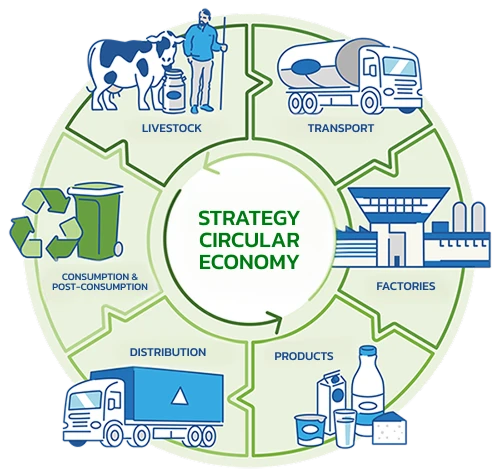
Environmental sustainability throughout our value chain
CLAS SAT
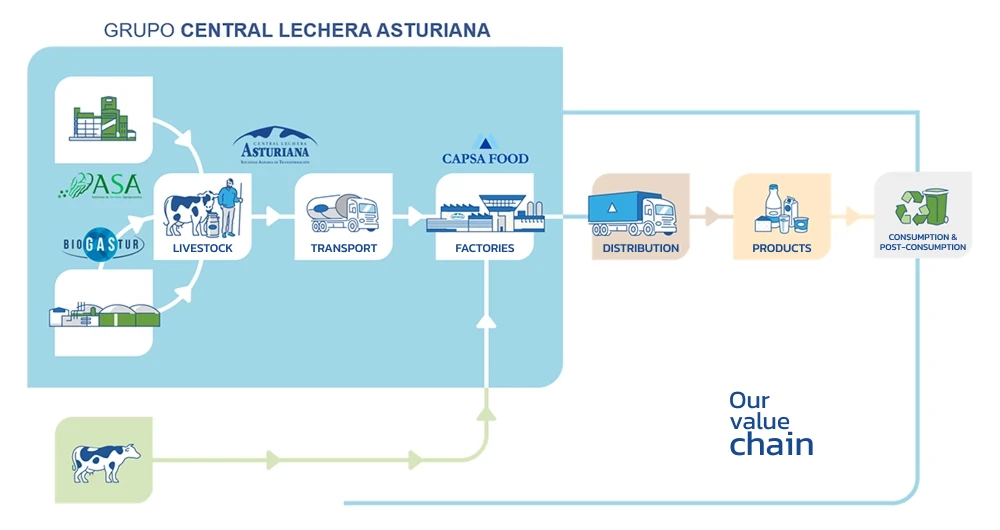
Coordinates milk collection and provides services to member livestock farms, contributing to improving their efficiency and advancing towards more sustainable production models from the source.
ASA
Produces animal feed and provides technical solutions that directly influence resource optimization and environmental performance in primary production.

CAPSA GROUP
(CAPSA Factories, Lácteas Flor de Burgos, and Cueva del Molin) transforms milk into dairy products and carries out its industrial activity under a continuous improvement approach oriented towards efficiency and impact reduction.

BIOGASTUR
Recovers slurry and organic waste, transforming them into renewable energy and organic fertilizers, and contributing to closing cycles within the value chain.
We enhance circularity
We promote more sustainable livestock farming

Measurement and improvement of environmental impact
The measurement of environmental footprints in livestock farming allows us to identify the main sources of impact and define effective improvement strategies. After several years of progress in this area, in 2025 we have consolidated this work with the calculation of the carbon footprint of all Central Lechera Asturiana member livestock farms, using a tool developed in collaboration with ODOS that allows for measuring, tracing, and simulating improvement scenarios. This reinforces our sectoral commitment to reduce the carbon footprint of the cooperative's livestock farms by 30% by 2030.
Use of renewable energy on farms
We promote the use of renewable energy; through the CLAS Energía program, participating farms consume 100% electrical energy with guarantees of renewable origin.
In addition, 17 farms have photovoltaic panel installations for energy self-consumption.
In addition, 17 farms have photovoltaic panel installations for energy self-consumption.

Circular economy applied to livestock farming
Through Biogastur, we recover slurry and organic waste from member livestock farms and Group factories, transforming them into biogas and biofertilizers. In 2025, we have made progress in obtaining biomethane for injection into the gas grid, reinforcing the circular economy, closing the waste cycle, and the Group's contribution to the energy transition.
Biodiversity and natural capital
The Group's livestock farms play a key role in the sustainable management of the territory and the conservation of natural capital. The maintenance of pastures, agricultural, and forest areas contributes to protecting biodiversity, preventing fires, conserving the landscape, and reinforcing the potential of these areas as carbon sinks. In this area, we promote projects such as GEPROCAR and ANCARES, which allow for progress in measuring carbon stored in soils and forest masses, improving territory monitoring, and optimizing agronomic practices such as fertilization.
Other alliances to mitigate climate change
We participate in consortia and innovation projects together with technology centers, cooperatives, and other sector agents to move towards a more sustainable, competitive, and low-carbon dairy model, addressing areas such as decarbonization, quality primary production, land management, circular economy, and knowledge exchange.
We optimize our industrial processes
We promote sustainable mobility
We eco-design packaging with a purpose
We foster our environmental commitment